Constraint Handling for Safe RL
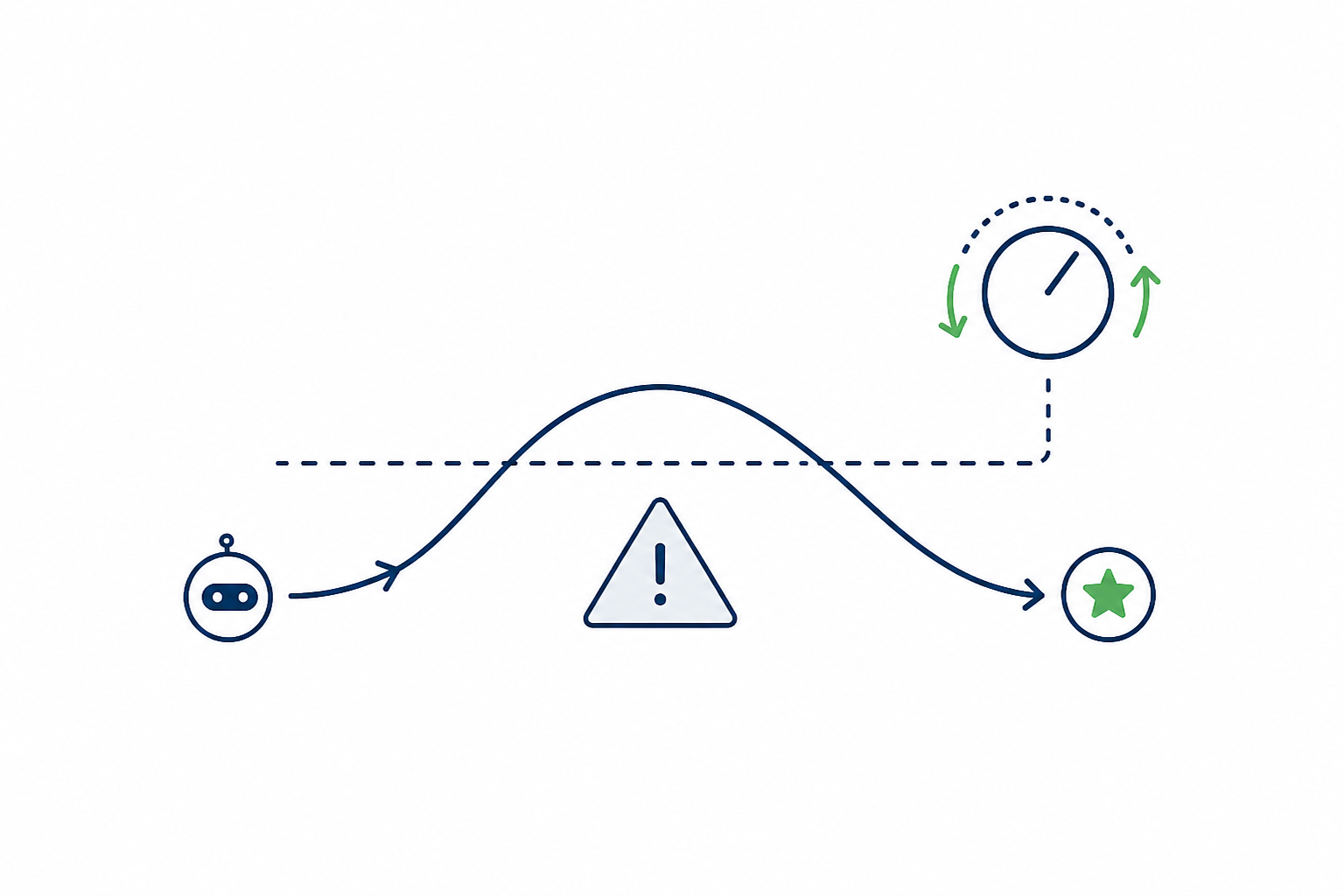
Changes Lagrangian or controller-style multiplier updates and cost-reward advantage mixing to improve reward while keeping episode cost below target.
Description
Safe RL: Constraint-Handling Mechanism Design
Research Question
Design a constraint-handling mechanism for safe reinforcement learning.
Your code goes in custom_lag.py, a subclass of PPO registered as
CustomLag. Reference implementations using a Lagrange multiplier
(PPOLag) and a PID controller (CPPOPID) are provided as read-only
*.edit.py baselines.
Background
Safe RL aims to maximize reward while keeping a long-run cost (e.g.
the count of safety violations) below a fixed limit. The standard
approach formulates the problem as a constrained MDP and converts it to
an unconstrained dual problem via a multiplier lambda updated from
the running cost violation. The mechanism that updates this multiplier
and combines reward and cost advantages directly determines the
agent's safety behavior:
- naive — constraint-unaware PPO baseline that ignores the safety constraint entirely; provides an upper bound on reward with no cost control.
- PPOLag — the multiplier is treated as a learnable parameter optimized by Adam to satisfy the dual objective. Simple but slow to react and prone to oscillation.
- CPPOPID — Stooke, Achiam and Abbeel, "Responsive Safety in
Reinforcement Learning by PID Lagrangian Methods"
(arXiv:2007.03964, ICML 2020). Replaces the integral-only Lagrange
update with a PID controller; the benchmark uses the paper-style
CPPOPID configuration with gains
kp = 0.1,ki = 0.01,kd = 0.01and a derivative delay window of 10 epochs (matchingomnisafe/common/pid_lagrange.py).
You must design:
- A multiplier update rule in
_update(). - An advantage combination formula in
_compute_adv_surrogate()that blends the reward advantageadv_rand cost advantageadv_cusing the current multiplier (e.g.(adv_r - lam * adv_c) / (1 + lam)in the standard Lagrangian baseline).
The PPO rollout loop, value functions, optimizer, environment interface, and registration plumbing are fixed.
Evaluation
Evaluated on Safety-Gymnasium navigation environments including:
- SafetyPointGoal1-v0 — point robot navigating to goals while avoiding hazards.
- SafetyCarGoal1-v0 — non-holonomic car robot with the same goal structure.
- SafetyPointButton1-v0 — point robot pressing goal buttons while avoiding hazards.
Each environment trains for the benchmark's fixed step budget. Metrics:
- Episode return (
reward) — higher is better. - Episode cost (
cost) — lower is better, with a target threshold of 25.0 per the Safety-Gymnasium convention used inomnisafe.
A method should achieve high return only when the cost constraint is controlled across all environments.
Code
1"""Custom Lagrangian-based safe PPO for MLS-Bench.23EDITABLE section: imports + constraint handling methods.4FIXED sections: algorithm registration, learn() with metrics reporting.5"""67from __future__ import annotations89import time1011import numpy as np12import torch1314from omnisafe.algorithms import registry15from omnisafe.algorithms.on_policy.base.ppo import PPO
1# Copyright 2023 OmniSafe Team. All Rights Reserved.2#3# Licensed under the Apache License, Version 2.0 (the "License");4# you may not use this file except in compliance with the License.5# You may obtain a copy of the License at6#7# http://www.apache.org/licenses/LICENSE-2.08#9# Unless required by applicable law or agreed to in writing, software10# distributed under the License is distributed on an "AS IS" BASIS,11# WITHOUT WARRANTIES OR CONDITIONS OF ANY KIND, either express or implied.12# See the License for the specific language governing permissions and13# limitations under the License.14# ==============================================================================15"""Implementation of Lagrange."""
1# Copyright 2023 OmniSafe Team. All Rights Reserved.2#3# Licensed under the Apache License, Version 2.0 (the "License");4# you may not use this file except in compliance with the License.5# You may obtain a copy of the License at6#7# http://www.apache.org/licenses/LICENSE-2.08#9# Unless required by applicable law or agreed to in writing, software10# distributed under the License is distributed on an "AS IS" BASIS,11# WITHOUT WARRANTIES OR CONDITIONS OF ANY KIND, either express or implied.12# See the License for the specific language governing permissions and13# limitations under the License.14# ==============================================================================15"""Implementation of PID Lagrange."""
1# Copyright 2023 OmniSafe Team. All Rights Reserved.2#3# Licensed under the Apache License, Version 2.0 (the "License");4# you may not use this file except in compliance with the License.5# You may obtain a copy of the License at6#7# http://www.apache.org/licenses/LICENSE-2.08#9# Unless required by applicable law or agreed to in writing, software10# distributed under the License is distributed on an "AS IS" BASIS,11# WITHOUT WARRANTIES OR CONDITIONS OF ANY KIND, either express or implied.12# See the License for the specific language governing permissions and13# limitations under the License.14# ==============================================================================15"""Implementation of the PPO algorithm."""
Method Summary
Adaptive PID-Lag with asymmetric advantage
PID Lagrangian targeting 80% of the cost limit, with violation-quadratic gain scheduling, anti-windup integral, predictive lookahead, and 1.5x cost penalty on cost-increasing actions.
Per epoch:1. ;\;2. gain scale ;\;3. EMA smoothed4. integral: if add else add ;\;clip5. EMA cost ;\;6. predictive trend7.8.