Efficient Diffusion Sampling for Robot Actions
Studies how sampling schedules and solver choices affect diffusion-generated robot action quality and inference time.
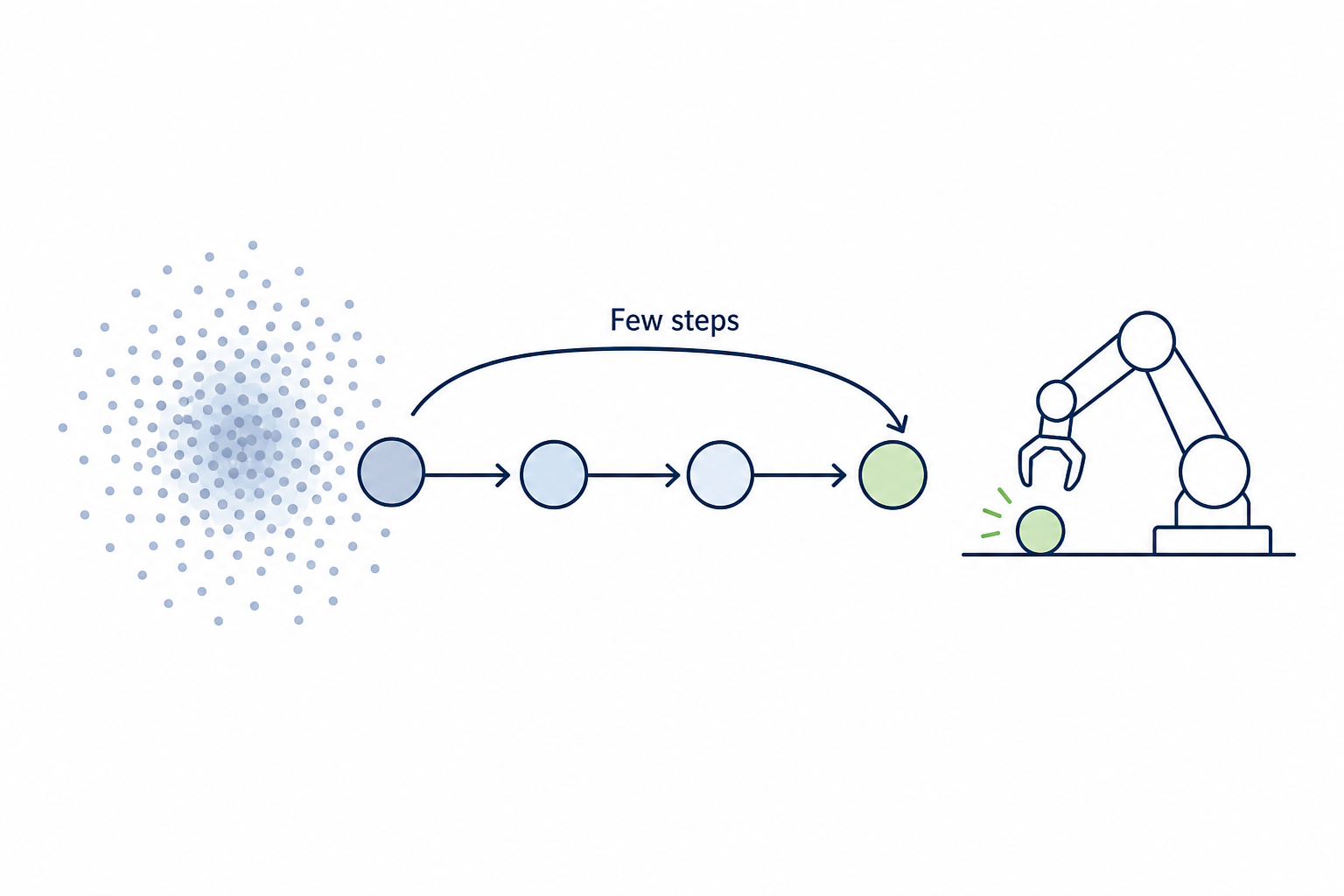
Description
Robo-Diffusion: Sampling Algorithm Design
Objective
Design a single efficient diffusion sampler for a fixed DQL-style diffusion policy, maximizing D4RL MuJoCo return at low inference NFE (number of function evaluations).
This task is deliberately about inference-time sampler choice, not policy learning, guidance, or trajectory planning. The trained actor / critic, dataset, environment list, seeds, and evaluation loop are fixed.
Background
A diffusion policy's wall-clock inference cost is dominated by the number of reverse-process steps. Different ODE / SDE solvers reach a given sample quality at different NFE budgets:
- DDPM (Ho, Jain, Abbeel, NeurIPS 2020, arXiv:2006.11239): the original Markovian sampler; high quality but slow.
- DDIM (Song, Meng, Ermon, ICLR 2021, arXiv:2010.02502): non-Markovian deterministic sampler that hits comparable quality in 10–50× fewer steps.
- DPM-Solver++ (Lu et al., 2022, arXiv:2211.01095): high-order ODE solver that reaches strong sample quality at ~10–20 steps for guided DPM sampling.
The setup builds on CleanDiffuser (Dong et al., NeurIPS 2024, arXiv:2406.09509) and the underlying actor is a DQL-style diffusion policy (Wang et al., ICLR 2023, arXiv:2208.06193) trained on D4RL (Fu et al., 2020, arXiv:2004.07219).
What You Can Modify
solverinCleanDiffuser/configs/custom/mujoco/mujoco.yamlsampling_stepsin the same YAML file
What Is Fixed
- The pipeline code, model architecture, critic, and training objective
diffusion_steps, training budgets, checkpoint selection, and EMA use- D4RL environment names, seeds, and vectorized evaluation
The score's NFE term is read from the same sampling_steps field passed to CleanDiffuser's sampler. Custom pipeline-code samplers are intentionally out of scope here because they would decouple true NFE from the reported score column.
Evaluation
Evaluated on three D4RL MuJoCo environments:
- hopper-medium-v2
- walker2d-medium-v2
- halfcheetah-medium-v2
Metrics: normalized_score (D4RL return) and sampling_steps (NFE per inference call).
Score formula
The per-env score multiplies a quality term by an NFE penalty:
score(env) = sigmoid(normalized_score) * penalty_upper(sampling_steps, target=10)
penalty_upper(x, target=10) = exp(-0.015 * (x - 10))   for x > 10
                              1.0                       for x <= 10
NFE penalty cheat-sheet:
| sampling_steps | penalty | example |
|---|---|---|
| 10 | 1.000 | DPM-Solver++ baseline |
| 20 | 0.861 | DDIM baseline |
| 50 | 0.549 | |
| 100 | 0.259 | DDPM baseline |
Task score is the geometric mean of the three env scores. Submitting at lower NFE is strictly preferred when quality is comparable.
Baselines
default
DDPM sampling with 100 steps — standard but slow. This is the unmodified
template baseline (registered as default in the config).
ddim
DDIM sampling with 20 steps — faster deterministic sampling.
dpm_solver
DPM-Solver++ with 10 steps — fast high-quality sampling.
Code
1import os2from copy import deepcopy34import d4rl5import gym6import hydra7import numpy as np8import torch9import torch.nn.functional as F10from torch.optim.lr_scheduler import CosineAnnealingLR11from torch.utils.data import DataLoader1213from cleandiffuser.dataset.d4rl_mujoco_dataset import D4RLMuJoCoTDDataset14from cleandiffuser.dataset.dataset_utils import loop_dataloader15from cleandiffuser.diffusion import DiscreteDiffusionSDE
1import os2from copy import deepcopy34import d4rl5import gym6import hydra7import numpy as np8import torch9import torch.nn.functional as F10from torch.optim.lr_scheduler import CosineAnnealingLR11from torch.utils.data import DataLoader1213from cleandiffuser.dataset.d4rl_mujoco_dataset import D4RLMuJoCoTDDataset14from cleandiffuser.dataset.dataset_utils import loop_dataloader15from cleandiffuser.diffusion import DiscreteDiffusionSDE
Method Summary
DPM-Solver++ 2M (10 NFE) + CGAR
Use a fast 10-step ODE sampler, then apply Critic-Guided Action Refinement: trust-region gradient ascent on Q at inference, no extra NFEs.
1. Set solver = ode_dpmsolver++_2M, sampling_steps = 102. At inference: actor.sample(...) // 10 NFE3. for r = 1..2 do // CGAR refinement (no diffusion calls)4. ;5.6. // trust region around original sample7.8. Use weighted Q-softmax over candidates as in baseline