Gradient Compression for Distributed Training
Studies how gradient compressors reduce distributed-training communication while preserving model accuracy.
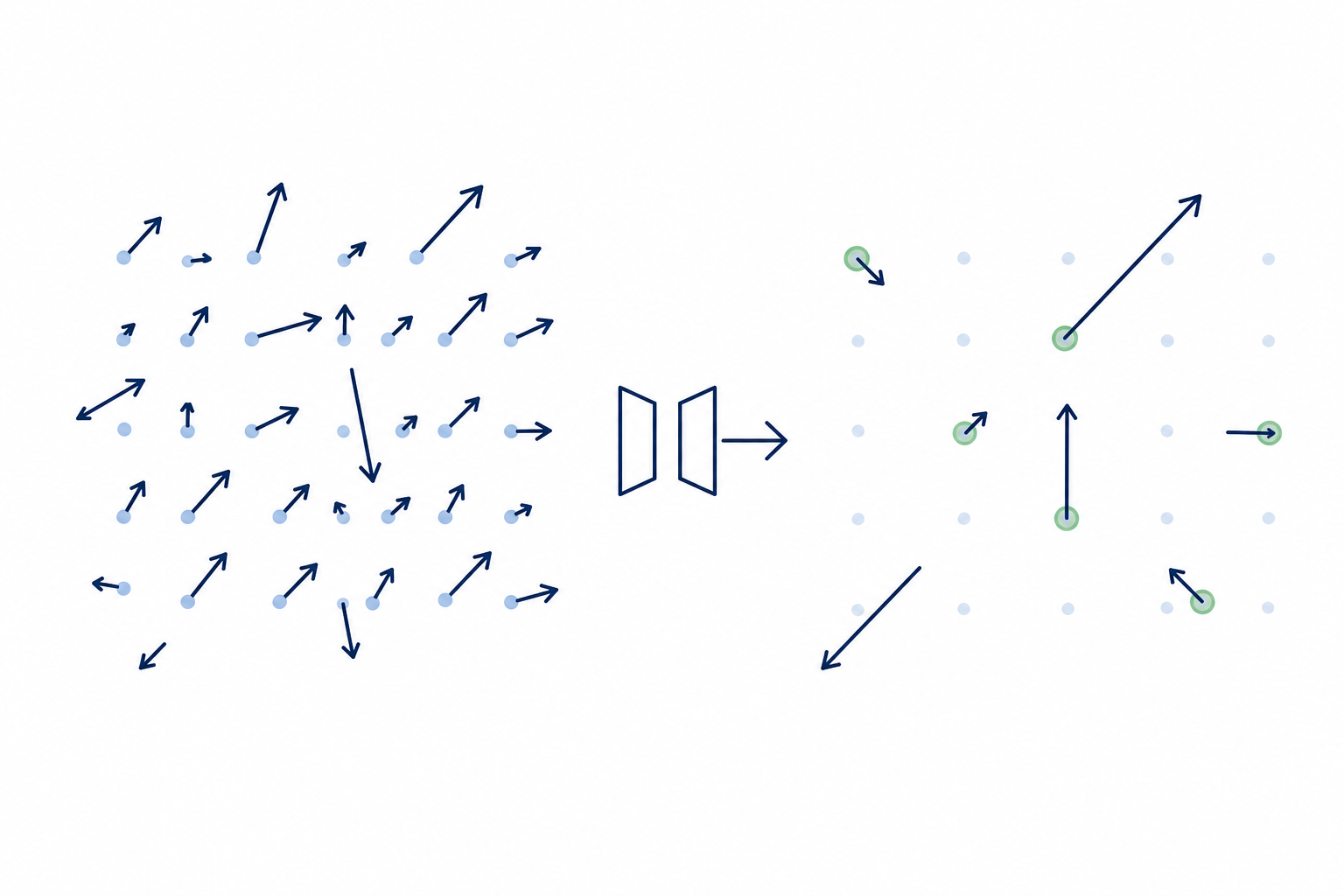
Description
Gradient Compression for Communication-Efficient Distributed Training
Research Question
Design a gradient compression operator that reduces communication cost in distributed training while maintaining convergence quality (test accuracy).
Background
In distributed data-parallel training, gradient communication is often the bottleneck. Workers compute local gradients, which must be aggregated (e.g., via all-reduce) before the optimizer step. Gradient compression reduces the volume of data communicated by applying lossy compression to gradients before transmission.
Three main families of compression exist:
- Sparsification: keep only a subset of gradient elements (e.g., TopK selects the largest magnitudes; Stich, Cordonnier, and Jaggi, "Sparsified SGD with Memory", NeurIPS 2018).
- Quantization: reduce the precision of gradient values (e.g., QSGD uses stochastic rounding to discrete levels).
- Low-rank approximation: approximate gradient matrices with low-rank factors (e.g., PowerSGD).
A key challenge is that naive compression introduces bias or variance that degrades convergence. Error feedback — accumulating compression residuals locally and adding them to the next gradient — is a widely used correction (Karimireddy, Rebjock, Stich, and Jaggi, "Error Feedback Fixes SignSGD and Other Gradient Compression Schemes", ICML 2019; arXiv:1901.09847).
Task
Modify the Compressor class in custom_compressor.py. Your compressor must implement:
__init__(self, compress_ratio): initialize with a target compression ratio (0.01= 100x compression).compress(self, tensor, name): compress a gradient tensor, returning(compressed_tensors, ctx).decompress(self, compressed_tensors, ctx): reconstruct the gradient.
The compressor may maintain internal state (e.g., error feedback residuals) across calls. The name parameter identifies parameters for per-parameter state tracking.
Interface
class Compressor:
    def __init__(self, compress_ratio=0.01): ...
    def compress(self, tensor, name) -> (list[Tensor], ctx): ...
def decompress(self, compressed_tensors, ctx) -> Tensor: ...compress_ratio: fraction of gradient elements/information to retain (0.01= keep 1%).compressed_tensors: list of tensors that would be communicated over the network.ctx: local context (not communicated) needed for decompression.- The decompressed tensor must have the same shape as the original input.
Evaluation
Trained and evaluated on three settings with 100x compression (compress_ratio = 0.01):
- ResNet-20 / CIFAR-10 (~0.27M params): small model, standard benchmark.
- VGG-11-BN / CIFAR-100 (~9.8M params): larger model, harder 100-class problem.
- ResNet-56 / CIFAR-10 (~0.85M params): deeper model, tests scalability.
Metric: best test accuracy (higher is better). All settings use SGD with momentum, cosine LR schedule, and 200 training epochs.
Baselines (paper-cited reference implementations)
- topk_ef — Top-K sparsification with error feedback (Stich et al., "Sparsified SGD with Memory", NeurIPS 2018; Karimireddy et al., "Error Feedback Fixes SignSGD and Other Gradient Compression Schemes", ICML 2019; arXiv:1901.09847). Keeps the
k = compress_ratio * dlargest-magnitude entries. - qsgd — Quantized SGD with stochastic uniform quantization (Alistarh, Grubic, Li, Tomioka, and Vojnovic, "QSGD: Communication-Efficient SGD via Gradient Quantization and Encoding", NeurIPS 2017; arXiv:1610.02132).
- signsgd — Sign-only gradient compression (Bernstein, Wang, Azizzadenesheli, and Anandkumar, "signSGD: Compressed Optimisation for Non-Convex Problems", ICML 2018; arXiv:1802.04434), typically combined with majority-vote aggregation.
A reference low-rank method (Vogels, Karimireddy, and Jaggi, "PowerSGD: Practical Low-Rank Gradient Compression for Distributed Optimization", NeurIPS 2019; arXiv:1905.13727) is a useful design point even though it is not run as a baseline here.
Code
1"""Gradient Compression for Communication-Efficient Distributed Training.23Self-contained benchmark: trains standard vision models on CIFAR datasets4using data-parallel SGD with a pluggable gradient compressor.56The script simulates distributed training on a single node by:71. Computing gradients normally82. Applying compress() -> decompress() to each gradient (simulating communication)93. Using the decompressed gradient for the optimizer step1011This faithfully measures the effect of gradient compression on convergence12quality, which is the core ML-science question, without requiring multi-node13infrastructure.14"""15
Method Summary
PowerSGD with two power iterations
Per-2D-tensor low-rank PQ approximation with warm-started Q, two power iterations and a QR re-orthogonalization, plus error feedback; small/1D tensors bypass compression.
1. if numel<256 or ndim<2: return tensor unchanged2. where is the residual3. with = compress_ratio4. or random; for 2 power steps: ;5. ; send6.7. decompress: