Quantization-Aware Language-Model Training
Studies how fake-quantization and quantize-dequantize behavior during finetuning affect low-bit language-model perplexity.
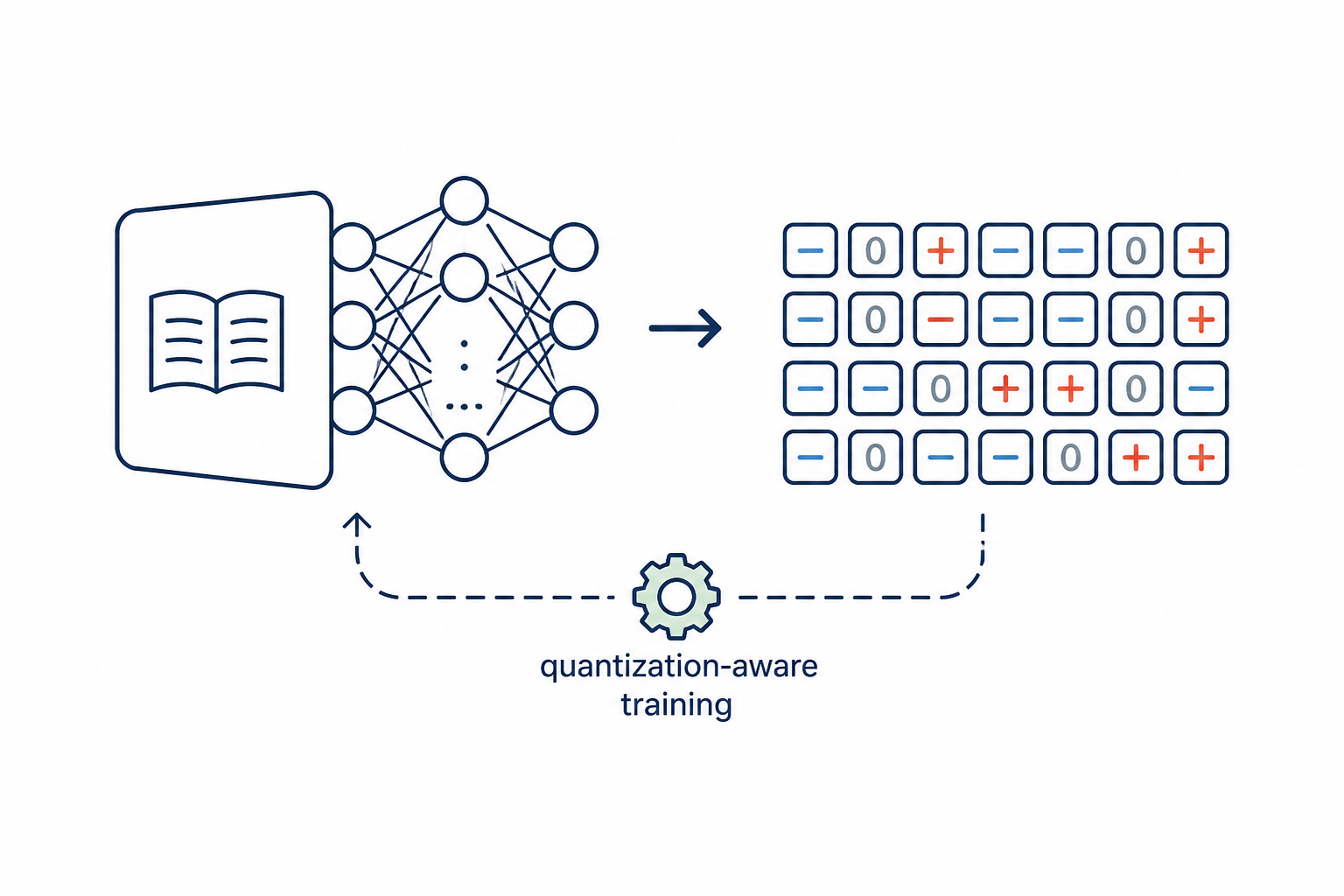
Description
LLM Quantization-Aware Training (QAT) Algorithm
Research Question
Design a quantization-aware training (QAT) algorithm that minimizes the perplexity gap between a full-precision Pythia-1.4B and the same model quantized to very low bit-widths (INT4 / INT3 / INT2) at inference time. The algorithm must be a training-side contribution: how the fake-quant forward, the gradient flow, the learnable parameters, and the optimizer schedule are designed. It must work uniformly across 4-, 3-, and 2-bit settings, not just one.
Background
Post-training quantization (PTQ) collapses at very low bit-widths because
every weight is rounded to one of 2^B levels with no chance to repair the
resulting error. Quantization-Aware Training (QAT) attacks this by
inserting fake quantization into the forward pass during a short
fine-tune. The key knobs are:
- Gradient estimator: round-then-clamp is non-differentiable. The Straight-Through Estimator (STE) (Bengio et al., 2013) simply pretends the operation is identity in backward. Learning the step size jointly with the weights — Learned Step Size Quantization (LSQ; Esser et al., ICLR 2020; arXiv:1902.08153) — gives a measurably tighter quantization grid and tends to dominate STE at INT2.
- Stability: low-bit QAT diverges easily; warming up the quantization noise and EMA-smoothing the scales (StableQAT-style) buys back several PPL points at INT2.
Group quantization (per-row, per-group of group_size=128 columns,
symmetric, signed) is the standard low-bit format and is fixed for this
task. Linear layers in every transformer block are quantized; embeddings,
LayerNorm, and the LM head stay full precision.
A control baseline finetune_then_ptq runs a full-precision finetune on
WikiText-2 train with the same schedule as the QAT methods (lr=2e-5,
500 steps, batch 2, grad-accum 4) and then applies the same RTN
quantize-dequantize as no_qat. This isolates the finetune signal from
the QAT signal: a useful QAT method must beat finetune_then_ptq,
otherwise its apparent gains over no_qat are just the in-domain
finetune talking.
What You Can Modify
The single file llm-qat-runtime/custom_qat.py is created at task setup;
you may only edit the # EDITABLE REGION START / END block. It contains:
CONFIG_OVERRIDESdict: per-method training hyperparameters (learning_rate,num_steps,batch_size,gradient_accumulation_steps,max_grad_norm,warmup_steps,weight_decay).fake_quantize_weight(weight, num_bits, group_size): differentiable fake-quant for the QAT forward pass. Must allow gradient flow back to the original weight.fake_quantize_activation(x, num_bits): optional (default identity for weight-only QAT).quantize_dequantize_weight(weight, num_bits, group_size): REAL (no-grad) per-group symmetric QDQ used after training to materialize the integer model for evaluation.class QATWrapper(nn.Module): wraps annn.Linear; applies fake quant inforward; may hold extra learnable parameters (per-group scales for LSQ, EMA buffers for StableQAT, etc.). May expose anaux_loss(step, total_steps)method that the training loop adds to the cross-entropy loss.prepare_qat_model(model, num_bits, group_size): replace everynn.Linear(and HF GPT-2Conv1D) in the model withQATWrapper, initializing any extra learnable parameters. The function must restore the LM head (embed_outfor Pythia / GPTNeoX,lm_headfor GPT-style models) to a plain Linear so the output projection stays in full precision.
The fixed (non-editable) region implements: model load (Pythia-1.4B in
FP32 with gradient checkpointing), WikiText-2 train data sampling
(block-1024 random crops), the QAT training loop (AdamW, cosine LR with
warmup, gradient accumulation, grad-norm clipping), real-quantization
roundtrip after training, and WikiText-2 test perplexity evaluation.
Architecture
- Backbone: HuggingFace
EleutherAI/pythia-1.4b(1.4B parameters, GPTNeoX architecture, 24 layers x 16 heads x 2048 hidden, native context length 2048). Linear layers are wrapped via the recursive traversal inprepare_qat_model. - Optimizer: AdamW, cosine schedule with linear warmup. Default 500 steps
x batch 2 x grad-accum 4 (~4000 sequences seen, seqlen 1024) — the
agent may shorten/lengthen via
CONFIG_OVERRIDES. - Calibration / training data: WikiText-2 raw v1 train split. Random 1024-token crops.
- Evaluation: WikiText-2 raw v1 test split, sliding non-overlapping blocks of 1024 tokens, exponentiated mean cross-entropy loss.
Interface
CONFIG_OVERRIDES = {
    "learning_rate": 2e-5,
    "num_steps": 500,
    "batch_size": 2,
    "gradient_accumulation_steps": 4,
    "max_grad_norm": 1.0,
    "warmup_steps": 50,
    "weight_decay": 0.0,
}

def fake_quantize_weight(weight, num_bits, group_size): ...   # differentiable
def fake_quantize_activation(x, num_bits): ...                # optional, default id
def quantize_dequantize_weight(weight, num_bits, group_size): # no-grad QDQ

class QATWrapper(nn.Module):
    def __init__(self, linear, num_bits, group_size): ...
    @property
    def weight(self) -> torch.Tensor: ...
    @property
    def bias(self): ...
    def forward(self, x): ...

def prepare_qat_model(model, num_bits, group_size): ...
Constraints:
- The forward path of every wrapped
nn.Linearmust usefake_quantize_weight(or an equivalent insideQATWrapper.forward) so the QAT signal actually trains the integer grid. - After training,
quantize_dequantize_weightis applied to everylinear.weightof everyQATWrapper, then perplexity is measured. Your method must produce weights that, after this real QDQ roundtrip, still give a low perplexity. - Keep the LM head at full precision (the template already excludes
embed_out/lm_head). - Available imports in the editable region:
torch,torch.nn(asnn),torch.nn.functional(asF),numpy(asnp),math,os,time, plustransformers.pytorch_utils.Conv1D. - All seeds and training hyperparameters must be deterministic given
--seed.
Evaluation
The algorithm is evaluated across three bit-widths:
qat-1b-int4: INT4, group size 128 — easy.qat-1b-int3: INT3, group size 128 — medium (8 levels).qat-1b-int2: INT2, group size 128 — extreme (4 levels).
Primary metric: wikitext2_ppl — WikiText-2 perplexity after the real
QDQ roundtrip, lower is better.
Secondary metric: degradation — wikitext2_ppl - fp16_ppl, where
fp16_ppl is the FP baseline measured before any quantization.
Note on absolute PPL vs. literature (OmniQuant / EfficientQAT tables):
QAT here finetunes on WikiText-2 train and evaluates on WikiText-2 test
(disjoint articles, but same domain). With 500 steps x bsz 2 x ga 4 =
4000 sequences x 1024 tokens, the FP16 finetune alone can drop test PPL
below the FP16 baseline (cf. finetune_then_ptq INT4 < no_qat FP16),
because the QAT train domain matches the eval domain. Published OmniQuant
/ EfficientQAT tables on LLaMA-{7B,13B} use C4 calibration and a
held-out WikiText eval, so their absolute W2g128 / W3g128 / W4g128
numbers are not directly comparable to ours. The intended internal
comparison is QAT-method vs finetune_then_ptq: a method that beats
finetune_then_ptq is showing real QAT signal, beyond the in-domain
finetune effect.
Reference baselines
no_qat
Round-to-nearest (RTN) post-training quantization with no fine-tuning — the pure PTQ lower bound.
ste
Straight-Through Estimator (Bengio et al., 2013): fake-quantize in the forward pass, pass the gradient through unchanged (identity) in the backward pass. The canonical minimal QAT gradient estimator.
lsq
Learned Step-Size Quantization (Esser et al., ICLR 2020, arXiv:1902.08153): learnable per-group quantization scales trained jointly with the weights, giving a tighter quantization grid than STE.
finetune_then_ptq
Full-precision fine-tune on WikiText-2 (same schedule as QAT methods) followed by RTN quantization. Isolates the in-domain fine-tune signal from the QAT signal; a valid QAT method must outperform this baseline.
Code
1"""Quantization-Aware Training (QAT) for Pythia-1.4B -- finetune + evaluate.23This script:41. Loads pretrained Pythia-1.4B (HF ``EleutherAI/pythia-1.4b``).52. Replaces every nn.Linear with QATWrapper that applies fake-quant in6forward (so gradients can flow back through the quantization).73. Runs a QAT fine-tune on WikiText-2 train (default ~1500 steps).84. Applies a REAL quantize-dequantize roundtrip to every linear weight.95. Evaluates perplexity on WikiText-2 test.1011The QAT algorithm is defined in the EDITABLE REGION below. Everything12else (data loading, training loop, real-quant roundtrip, perplexity eval)13is fixed and shared by every baseline and the agent.14"""15
Method Summary
Bit-adaptive LSQ + noise warmup
LSQ scales initialized at a bit-aware fraction of |W|_max with a noise-mix warmup, plus an annealed outlier hinge and an in-grid attraction term.
1. init s_g ← clip_ratio·max|W_g|/qmax (clip_ratio = 0.95@4, 0.90@3, 0.80@2)2. ŵ ← LSQQuantFn(W, s, qmin, qmax, g_scale·(1+2/qmax))(LSQ gradient on s, STE on W, but with a bit-amplified scale-grad)3. forward weight = (1-α)·W + α·ŵ where α ramps 0→1 over [0, warmup_frac·T]warmup_frac = 0.25 / 0.35 / 0.50 for 4 / 3 / 2 bits4. aux_loss:a) outlier hinge: , β anneals 0.05→0.01, ×3 at INT2b) after warmup, in-grid attraction: (×5 at INT2)