3D Scene Densification Strategy
Studies how clone, split, prune, reset, relocation, and sampling policies affect novel-view scene reconstruction.
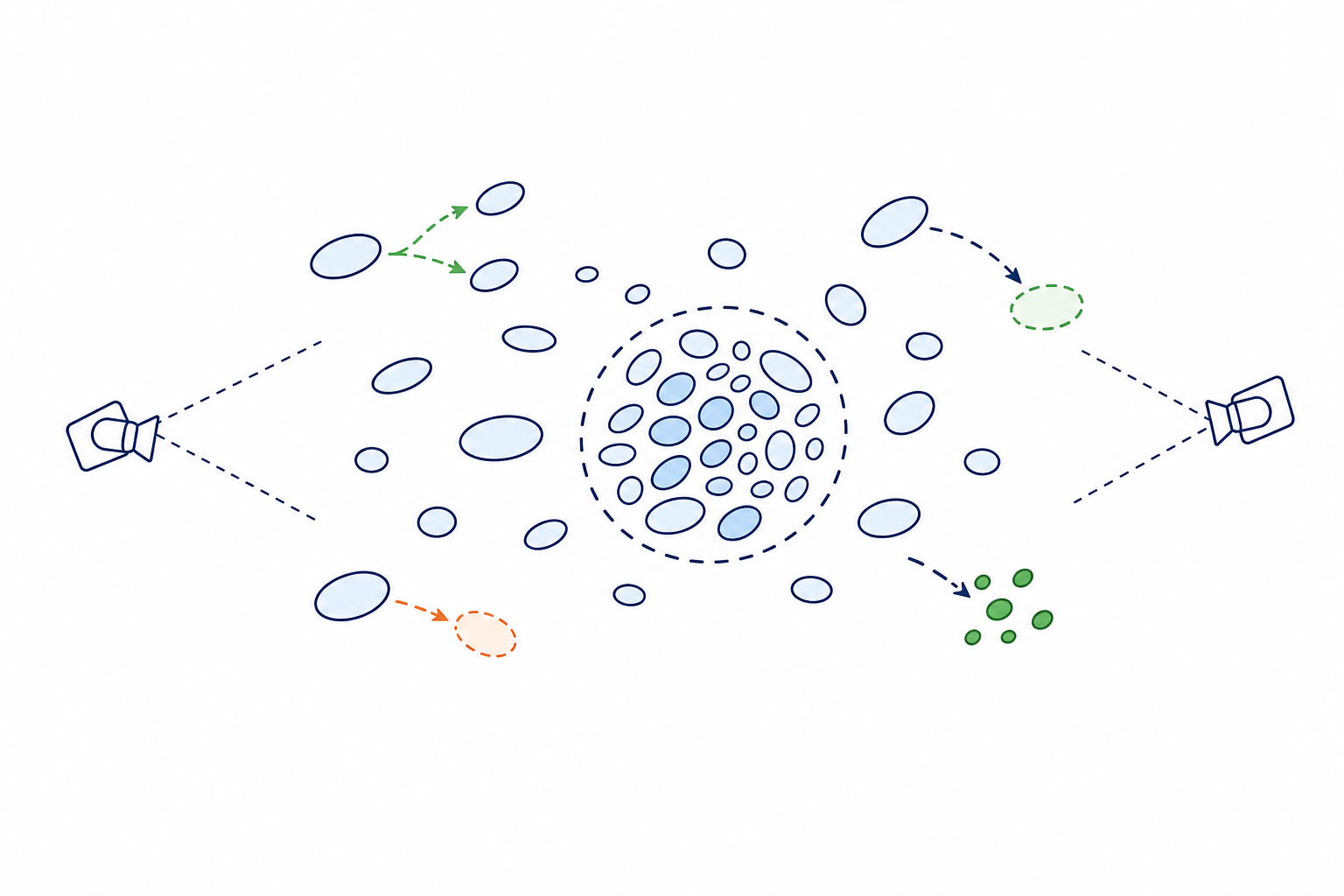
Description
3D Gaussian Splatting Densification Strategy
Objective
Design a densification strategy for 3D Gaussian Splatting (3DGS) that improves novel view synthesis quality on real-world scenes under a fixed training and rendering pipeline.
Background
3D Gaussian Splatting (Kerbl et al., SIGGRAPH 2023) represents scenes as collections of anisotropic 3D Gaussians optimized via differentiable rasterization. A central component of training is the densification strategy, which controls how Gaussians are added, split, pruned, or otherwise reorganized during optimization. Common operations include:
- Clone small Gaussians in under-reconstructed regions.
- Split large Gaussians into smaller ones to recover finer detail.
- Prune transparent or oversized Gaussians.
- Reset opacities periodically to encourage pruning of redundant Gaussians.
Recent work proposes various refinements:
- AbsGS (Ye et al., arXiv:2404.10484) — homodirectional view-space gradient using the absolute value of per-pixel sub-gradients to overcome over-reconstruction caused by gradient cancellation.
- Mini-Splatting (Fang & Wang, arXiv:2403.14166) — blur-aware splitting and importance-weighted stochastic sampling for Gaussian count control.
- 3DGS-MCMC (Kheradmand et al., NeurIPS 2024 Spotlight, arXiv:2404.09591) — treats densification as Markov-Chain Monte Carlo sampling, replacing cloning with a relocation step that preserves the sampled distribution.
- Taming-3DGS (Mallick et al., SIGGRAPH Asia 2024, arXiv:2406.15643) — budgeted per-step densification controlled by maximum gradient blending.
- EDC: Efficient Density Control (Deng et al., arXiv:2411.10133) — long-axis splitting with explicit child-Gaussian opacity control plus recovery-aware pruning.
Implementation Contract
Implement a CustomStrategy class in custom_strategy.py. The strategy
controls the full lifecycle of Gaussians during training via two hooks called
by the training loop:
@dataclass
class CustomStrategy(Strategy):
    def initialize_state(self, scene_scale: float = 1.0) -> Dict[str, Any]:
        # Initialize running statistics for the strategy.
        ...

    def step_pre_backward(self, params, optimizers, state, step, info):
        # Called BEFORE loss.backward(). Use to retain gradients.
        ...

    def step_post_backward(self, params, optimizers, state, step, info, packed=False):
        # Called AFTER loss.backward() and optimizer.step().
        # Implement densification / pruning logic here.
        ...
Available Operations (gsplat.strategy.ops)
duplicate(params, optimizers, state, mask)— clone selected Gaussians.split(params, optimizers, state, mask)— split selected Gaussians (sample 2 new positions from the covariance).remove(params, optimizers, state, mask)— remove selected Gaussians.reset_opa(params, optimizers, state, value)— reset all opacities to a value.relocate(params, optimizers, state, mask, binoms, min_opacity)— relocate dead Gaussians on top of live ones.sample_add(params, optimizers, state, n, binoms, min_opacity)— add new Gaussians sampled from the opacity distribution.inject_noise_to_position(params, optimizers, state, scaler)— perturb positions with Gaussian noise.
Available Information
The info dict passed in by the rasterizer contains:
means2d— 2D projected means (with.gradafter backward).width,height— image dimensions.n_cameras— number of cameras in the batch.radii— screen-space radii per Gaussian.gaussian_ids— which Gaussians are visible.
The params dict contains:
means—[N, 3]positions.scales—[N, 3]log-scales (usetorch.exp(...)for actual scales).quats—[N, 4]rotation quaternions.opacities—[N]logit-opacities (usetorch.sigmoid(...)for actual opacities).sh0,shN— spherical-harmonic colour coefficients.
Fixed Pipeline
The following are FIXED across all strategies and must not be changed:
- Renderer:
gsplatCUDA rasterizer. - Optimizer: AdamW with per-parameter learning rates.
- Photometric loss:
0.8 * L1 + 0.2 * SSIMper training step. - Training: 30,000 steps per scene.
- SH degree: 3 (increased gradually during training).
Baselines
| Baseline | Description |
|---|---|
absgrad | gsplat DefaultStrategy with the AbsGS absolute-gradient criterion (Ye et al., arXiv:2404.10484). |
taming | Taming-3DGS budgeted densification with max-grad blending (Mallick et al., arXiv:2406.15643), combined with the AbsGS gradient and the revised opacity formula. |
edc | Taming densification combined with EDC long-axis splitting and recovery-aware pruning (Deng et al., arXiv:2411.10133). |
Evaluation
Evaluation uses Mip-NeRF 360 scenes (Barron et al., 2022) with every 8th image held out for testing. Metrics:
| Metric | Direction | Description |
|---|---|---|
| PSNR | higher is better | Peak signal-to-noise ratio (primary metric). |
| SSIM | higher is better | Structural similarity. |
| LPIPS | lower is better | Learned perceptual similarity. |
Scoring uses per-scene PSNR. The contribution should be a transferable densification rule, not a change to the renderer, photometric loss, optimizer, dataset, or evaluation protocol.
Code
1"""Custom densification strategy for 3D Gaussian Splatting.23This file defines the CustomStrategy class that controls how Gaussians4are added, split, and pruned during per-scene optimization.5"""67from dataclasses import dataclass8from typing import Any, Dict, Tuple, Union910import math11import torch12from gsplat.strategy.base import Strategy13from gsplat.strategy.ops import (14duplicate, split, remove, reset_opa,15relocate, sample_add, inject_noise_to_position,
Method Summary
Opacity-Gated, Annealed Densification
AbsGrad + (avg, max)-blended growth signal with an annealed threshold and an opacity gate; uses revised-opacity split.
1. for each step, accumulate (AbsGS) → grad2d, grad2d_max2. every refine_every steps after warmup:3.4. // annealed coarse→fine5. high // opacity gate6. duplicate small ∧ high; split large ∧ high with revised_opacity=True7. prune or oversized8. reset opacity to every 3000 steps; stop refining at 19k